Solid vs Engineered Oak Parquet: Which Is Right for Your Project
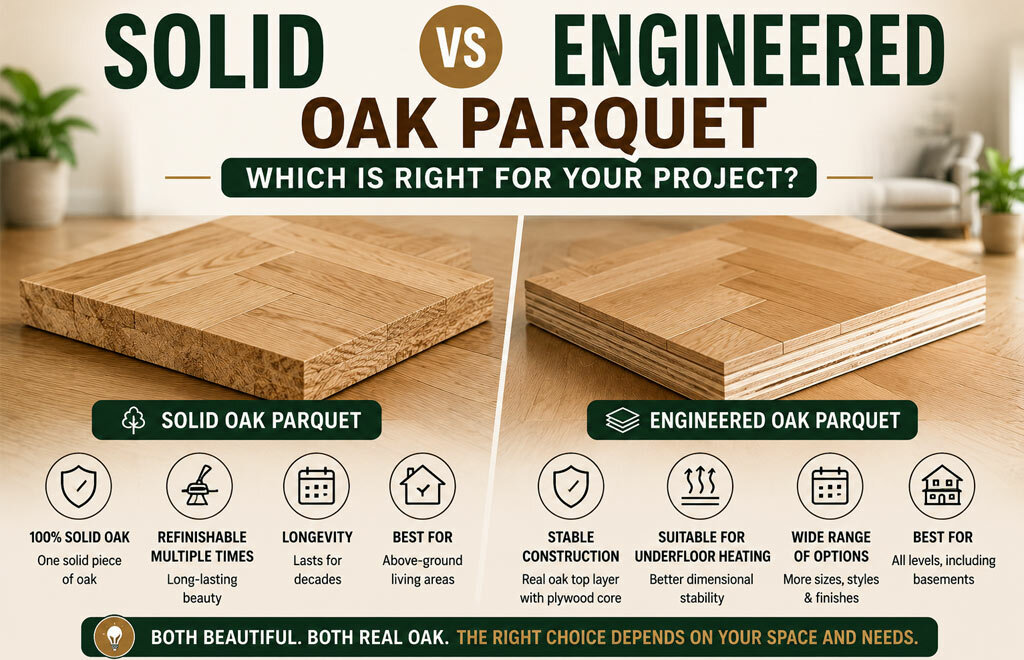 Oak parquet is available in both solid and engineered formats, and the choice between them has practical consequences for installation, performance and long-term maintenance. Understanding what each format offers and where each performs best ensures you choose the right product for your specific conditions.
Solid Oak Parquet
Traditional solid oak parquet blocks are 20mm or more of solid timber throughout. They have the greatest depth of material available for sanding over the floor's lifetime, and they provide the most authentic material character for period property installations. Reclaimed solid parquet blocks, available from salvage suppliers, are the most historically authentic option for genuine period restorations.
Solid parquet is typically glued to the subfloor using MS polymer adhesive on concrete subfloors or a wood-specific adhesive on timber subfloors. It is sensitive to moisture and temperature variation: significant fluctuations in room humidity cause the blocks to expand and contract across their width. This is manageable with appropriate installation (correct expansion gaps) and humidity management, but solid parquet over underfloor heating requires very careful design and ongoing attention.
Junckers is the most established manufacturer of solid hardwood sports floors in the UK, and their solid floor installation guidance and system products are well developed for demanding applications including sports facilities and commercial buildings.
Engineered Oak Parquet
Engineered parquet uses a real oak top layer (typically 3mm to 6mm thick) bonded to a multi-ply plywood core. The plywood core is more dimensionally stable than solid wood and handles changes in temperature and humidity better. This makes engineered parquet substantially more forgiving to install and less demanding to maintain over time.
Engineered parquet is compatible with underfloor heating within the standard floor surface temperature limit of 27 degrees Celsius, which makes it the practical choice for modern homes and extensions with UFH. It is available pre-finished from multiple European manufacturers, which means installation to a finished floor on the same day is possible without waiting for site finish to dry and cure.
The limitation of engineered parquet is the wear layer depth. A 3mm wear layer allows at most one light sanding over the floor's lifetime. A 6mm wear layer is more generous and allows the floor to be refinished multiple times. For a floor expected to last many decades and to be sanded periodically, a 6mm wear layer engineered product is a much better long-term investment.
Making the Choice
- Solid: best for period restorations, reclaimed character, maximum sanding depth
- Engineered: best for UFH compatibility, dimensional stability, pre-finished convenience
- Solid over UFH: possible but requires careful specification and humidity management
- Engineered 6mm wear layer: best long-term investment in engineered format
- Both formats finished with Osmo or Bona produce excellent results
For most UK residential projects today, engineered oak parquet with a 4mm or 6mm wear layer is the practical recommendation. Its compatibility with modern construction conditions, including underfloor heating and concrete subfloors, makes it more adaptable than solid parquet while still providing a genuine oak floor that can be sanded and refinished over a long lifespan.