Flooring and Allergies: Best Options for Allergy Sufferers
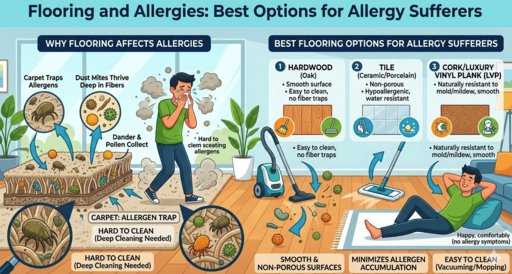
If you or someone in your household suffers from asthma, hay fever, or dust mite allergies, your flooring choice matters more than you might think. The right hypoallergenic flooring for homes can reduce the accumulation of triggers significantly, while the wrong choice can make symptoms worse year-round. This guide cuts through the noise and tells you exactly what to choose, what to avoid, and why.
Why Flooring Affects Allergy Symptoms
Indoor air quality is directly influenced by what's on your floor. Allergens — dust mites, pet dander, pollen, mould spores — settle from the air and accumulate in flooring materials. The key variable is how easily those allergens can be removed during cleaning.
Carpet, particularly thick-pile carpet, acts like a reservoir. It traps allergens deep within its fibres where a standard vacuum cannot reach them. Disturbing the carpet — by walking on it, for example — releases those particles back into the air. Research consistently links carpet in bedrooms and living rooms to higher concentrations of dust mite allergens, which are one of the most common triggers for asthma attacks in the UK.
Hard flooring, by contrast, offers no place for allergens to hide. They settle on the surface and — with the right cleaning method — can be removed entirely. That's the fundamental argument for hard floors in allergy-sensitive homes.
The Best Flooring Choices for Allergy Sufferer
Not all hard floors are equal when it comes to allergy management. Surface texture, finish, and material composition all affect how easily allergens accumulate and how thoroughly they can be cleaned.
- Smooth Luxury Vinyl Tile (LVT): The most practical option for allergy sufferers. LVT has a smooth, sealed surface with no open grain or texture for particles to settle into. It's fully waterproof, tolerates damp mopping, and is resilient underfoot. It's also one of the more affordable hard flooring options, making it well-suited to bedrooms — the room where dust mite exposure matters most.
- Lacquered hardwood or engineered wood: A lacquer finish seals the wood's surface completely, preventing allergens from lodging in the grain. This is an important distinction — lacquered wood is significantly better for allergy sufferers than oiled wood. The hard, smooth surface wipes clean easily and doesn't harbour particles the way an open-grained, oiled finish does.
- Polished or sealed concrete: An increasingly popular choice in contemporary homes. A polished or epoxy-sealed concrete floor has virtually no surface texture and is exceptionally easy to maintain. With no joins, no grout lines, and no fibres, there are very few places for allergens to accumulate.
- Ceramic or porcelain tiles: Tiles are inherently non-porous and easy to wipe clean. The main consideration is grout lines — these can trap dust if not properly sealed. Use an epoxy grout or ensure standard grout is sealed and maintained regularly.
What to Avoid If You Have Allergies
Certain flooring types are particularly problematic for allergy sufferers, and it's worth understanding why before making a decision you'll live with for years.
- Thick-pile carpet: The worst offender. Deep pile provides ideal conditions for dust mites — warmth, humidity retention, and protection from vacuums. Even HEPA-filter vacuums struggle to extract mites and their waste matter from deep within the carpet pile. If you're an allergy sufferer, thick-pile carpet in bedrooms or living rooms is best avoided entirely.
- Oiled wood flooring: Oiled finishes leave the wood grain open by design. This gives a natural, tactile appearance, but it also creates a surface that traps fine particles. Oiled floors require more frequent and more thorough cleaning to remain allergen-free, and they cannot be damp mopped in the same way a lacquered floor can.
- Cork flooring: Cork has an open, porous texture that makes it difficult to clean thoroughly. It also absorbs moisture, which can encourage mould growth — itself a significant allergen. Despite its natural credentials, cork is not a good choice for allergy-sensitive households.
- Textured or embossed vinyl: Budget vinyl with a heavily textured or embossed surface mimics the look of wood grain or stone but creates small crevices where dust accumulates. Smooth LVT avoids this problem — textured alternatives do not.
VOC Emissions and Indoor Air Quality
Allergens aren't the only indoor air quality concern. Volatile organic compounds (VOCs) — chemical gases emitted by flooring materials, adhesives, and finishes — can irritate the respiratory system and trigger or worsen allergy and asthma symptoms. This is particularly relevant in the weeks and months after new flooring is installed.
When selecting hypoallergenic flooring properties, look for products carrying recognised low-VOC certifications:
- FloorScore: An internationally recognised certification for hard surface flooring. Products carrying the FloorScore mark have been independently tested and meet strict VOC emission limits.
- GREENGUARD Gold: A rigorous certification that tests for over 360 chemicals. GREENGUARD Gold certified products are deemed safe for use in sensitive environments, including schools and healthcare settings — a reassuring benchmark for allergy-conscious homeowners.
When installing new flooring, ensure the room is well ventilated for at least 48–72 hours after fitting. This is especially important with any adhesive-bonded installation. If possible, allow the flooring to off-gas in an unoccupied room before spending extended time there.
Cleaning Methods That Actually Work
Even the best hypoallergenic flooring that households can install will underperform if cleaned incorrectly. The goal of cleaning an allergen-free floor is to remove particles — not redistribute them.
- Use a microfibre mop, not a dry brush or broom: Microfibre cloths and mop heads work electrostatically to trap and hold particles rather than pushing them back into the air. A traditional broom or dry mop scatters fine dust and allergens across the room and into the air — the opposite of what you want.
- Damp mopping is more effective than dry cleaning alone: For LVT, sealed wood, tiles, and concrete, a lightly damp microfibre mop will capture fine particles that a dry cloth misses. Use plain water or a pH-neutral floor cleaner — avoid strong chemical cleaners that may off-gas irritants.
- Clean frequently: In homes with pets or high pollen exposure, daily mopping of key rooms (particularly bedrooms) makes a measurable difference to allergen load. It takes less time with a microfibre flat mop than it sounds.
- Use a vacuum with a HEPA filter on hard floors too: HEPA-filtered vacuums capture fine particles, including dust mite matter and pollen, without releasing them back into the air. This is worth using before mopping to collect larger debris first.
- Don't neglect skirting boards and floor edges: Allergens accumulate heavily in corners and along skirting boards. Include these in your regular cleaning routine.
Flooring Type Comparison at a Glance
| Flooring Type |
Allergen Accumulation |
Ease of Cleaning |
Recommended? |
| Smooth LVT |
Very low |
Excellent |
✓ Yes |
| Lacquered wood/engineered wood |
Low |
Good |
✓ Yes |
| Polished/sealed concrete |
Very low |
Excellent |
✓ Yes |
| Ceramic/porcelain tile (sealed grout) |
Low |
Good |
✓ Yes |
| Oiled wood |
Moderate |
Moderate |
✗ Avoid |
| Cork |
Moderate–High |
Poor |
✗ Avoid |
| Textured vinyl |
Moderate |
Moderate |
✗ Avoid |
| Thick-pile carpet |
Very high |
Poor |
✗ Avoid |
Key Takeaways
- Hard floors are significantly better than carpet because they do not trap allergens deep within fibres and can be cleaned more effectively.
- Smooth, sealed surfaces are the best option — materials such as LVT, lacquered wood, polished concrete, and ceramic tiles allow allergens to remain on the surface where they can be easily removed.
- Avoid porous or textured flooring materials like thick carpets, cork, heavily textured vinyl, or open-grain oiled wood that can trap dust, pollen, and pet dander.
- Choose low-VOC certified products to reduce indoor air pollution and minimise respiratory irritation after installation.
- Regular cleaning makes a major difference — using a HEPA-filter vacuum and damp microfibre mopping removes allergens instead of redistributing them around the room.
For households dealing with asthma, hay fever, or dust mite sensitivity, the right flooring choice can noticeably improve everyday comfort. By prioritising smooth, sealed hard floors and maintaining a consistent cleaning routine, you can significantly reduce allergen build-up and create a healthier indoor environment for everyone in your home.