How to Apply Floor Lacquer: A Step-by-Step Guide
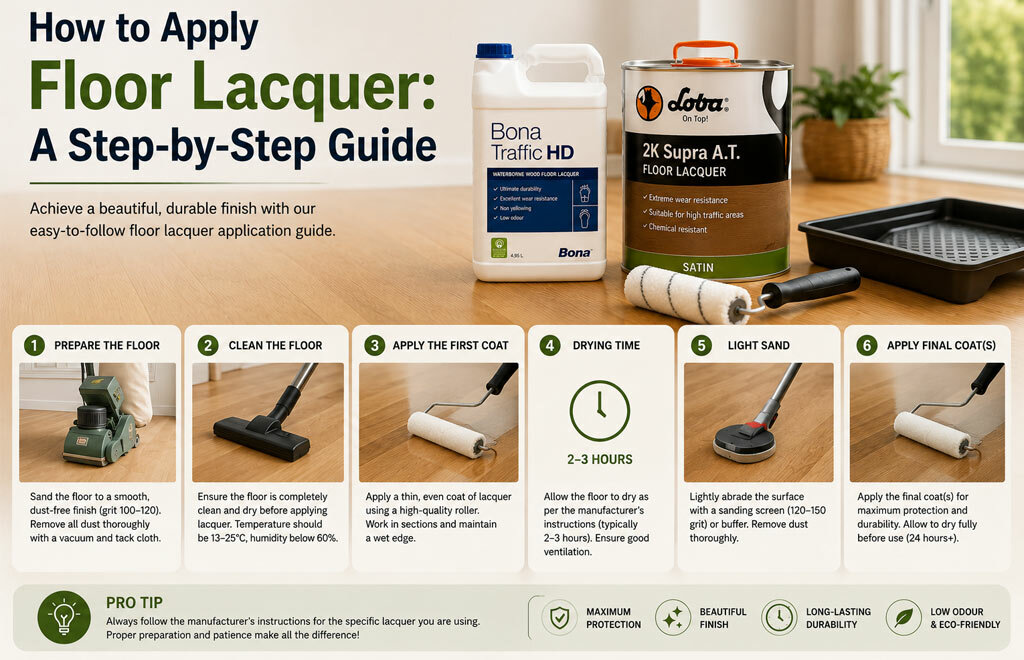
Applying floor lacquer is a task that rewards careful preparation and attention to timing. Getting it right means a floor that is both beautiful and durable. Getting it wrong, whether through insufficient sanding, inadequate drying times or poor application technique, means visible problems that are difficult to rectify without starting again.
This guide covers the complete process from subfloor preparation through to the final lacquer coat, with specific guidance on using products from Bona, Loba and Junckers, which are the three most widely used lacquer systems in the UK market.
Preparation: Sanding the Floor
Floor lacquer performs only as well as the surface beneath it. Sanding removes the existing finish (if any), levels the surface across all boards, and opens the wood grain to accept the new coating. This is done using a drum sander for the main field area and an edge sander for the perimeters. Disc or orbital sanders are used for corners and difficult areas.
For new or previously unfinished floors, a progression of 40-grit, 60-grit and 80-grit sanding papers is standard. For floors with an existing finish, start coarser if needed. The final sanding pass with 80-grit or 100-grit should leave a clean, consistent surface across the whole floor. Always sand in the direction of the grain, or at a slight diagonal on stubborn areas, then finish with the grain direction.
After sanding, vacuum the floor thoroughly and wipe down with a slightly damp microfibre cloth to remove all dust. Fine sanding dust in the lacquer coat causes cloudiness and a rough texture. Allow the floor to dry completely before applying any coating.
Choosing and Applying the Seal Coat
Most lacquer systems require a seal coat (sometimes called a primer or sealer coat) before the main lacquer coats. The seal coat penetrates the wood grain and provides a base for the lacquer to bond to. Bona recommends using Bona Prime Classic or Bona Prime Intense as a seal under Bona Traffic HD. Loba's system uses Loba Sealer under its 2K lacquers. Junckers Strong Seal is the standard primer for Junckers lacquer systems.
Apply the seal coat using a high-quality floor lacquer application pad or T-bar applicator. Work in manageable sections, applying the seal in long strokes parallel to the boards. Do not overwork the product or apply too thick a coat. The seal coat is absorbed into the wood rapidly; you will see it darken the timber initially before it starts to dry. Typical drying time is one to two hours at room temperature before the first lacquer coat can be applied.
Applying the Lacquer Coats
Most systems require a minimum of two lacquer coats, though three coats is the professional standard for residential use and provides noticeably better durability. Between coats, the floor must be lightly abraded with a screen or 100-grit to 120-grit abrasive pad to degloss the surface and help the next coat bond. This intermediate screening is essential; skipping it risks the coats delaminating under stress.
Apply each coat using the same T-bar applicator or a wide application pad designed for lacquers. Work quickly but methodically, keeping a wet edge to avoid lap marks. In hot conditions, lacquer can dry at the edges before the centre of a large area is reached, creating visible lines. Work in sections if the room is very large or conditions are warm.
Bona Traffic HD is a water-based two-component lacquer that requires the addition of a hardener before use. Once mixed, the pot life is typically four to six hours. Mix only what you can apply within that period. Follow the manufacturer's specific dilution and application rate guidance, as these products are calibrated for specific film thicknesses.
Drying and Curing Times
Water-based lacquers from Bona, Loba and Junckers typically allow light foot traffic after 12 to 24 hours for each coat. However, full hardness is not achieved until the lacquer has cured completely, which takes five to seven days depending on temperature and humidity. During this period, heavy furniture should not be returned to the room, and rugs should not be placed on the floor. Rugs placed on an under-cured lacquer can cause permanent marks.
Avoid washing the floor with water-based cleaners for the first seven days after the final coat. Use a dry microfibre mop or a lightly dampened cloth for the first week.
Common Mistakes to Avoid
- Insufficient sanding between coats leads to poor adhesion and visible lines
- Applying too thick a coat causes the surface to wrinkle or remain tacky
- Applying in too warm or humid conditions causes premature drying and lap marks
- Using a dirty applicator transfers debris into the wet lacquer
- Mixing two-component products at the wrong ratio affects both drying and final hardness
- Returning furniture or rugs to a floor that has not fully cured
A professionally applied lacquer finish from Bona, Loba or Junckers will last many years with proper maintenance. The application process itself is not technically beyond a careful DIYer, but it does require the right equipment, the right conditions and a methodical approach. For large or complex floors, engaging a professional floor finisher generally produces a better result.