Engineered Oak Parquet Blocks: What to Look for When Buying
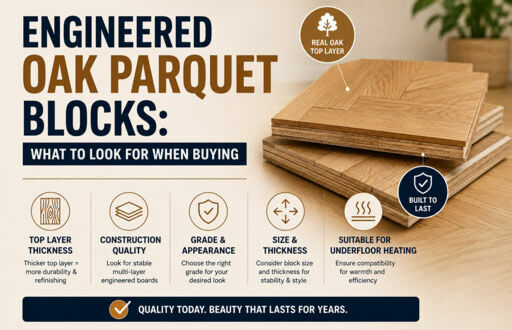
Engineered oak parquet blocks are not all alike. The gap between a budget engineered herringbone product and a quality European-manufactured one is significant in terms of construction quality, finish durability and longevity, even if they look similar in a photograph. Understanding what to look for in engineered oak parquet blocks allows you to make informed comparisons and choose products that will perform well over a long period.
Wear Layer Depth: The Most Important Specification
The wear layer is the top layer of real oak on an engineered block. Its thickness determines how many times the block can be sanded and refinished over its lifetime. A 2mm wear layer allows at most one very light sand; a 6mm wear layer can be sanded two to three times, potentially extending the floor's life over several decades. For a floor you intend to keep for a long time, the wear layer specification is the most important number to check.
Wear layer thickness is usually specified in the product documentation. Be wary of products where the specification is ambiguous or where total board thickness is stated without specifying the wear layer component. A 14mm total board thickness could have a 2mm wear layer or a 4mm wear layer depending on the core construction; the total thickness tells you nothing about longevity without the wear layer detail.
Core Construction
The core beneath the wear layer is typically multi-ply plywood or HDF (high-density fibreboard). Plywood cores are more stable and have better acoustic properties than HDF cores. The number of plywood layers (ply count) in the core affects dimensional stability: a 7-ply or 9-ply core is more stable than a 5-ply one. Look at the end of a sample block to count the visible ply layers; more layers indicate better construction in most cases.
Grade and Surface Character
Oak parquet blocks are graded by visual character. Prime or select grade blocks have minimal knots, consistent colour and tight straight grain. Character or rustic grade blocks have more variation, including knots, colour shifts and pronounced ray figures. The grade affects appearance, not durability. Choose the grade based on the visual character you want in the finished floor.
Pre-finished Options
Pre-finished engineered parquet blocks arrive with a factory-applied UV oil or UV lacquer. These finishes are hard and durable, applied under controlled conditions that cannot be replicated on-site. The advantages are immediate use after installation and consistent factory finish quality. The disadvantages are that factory finishes are often harder to recoat or repair than site-applied finishes, and the colour range is fixed to what the manufacturer produces.
- Wear layer: minimum 3mm for a quality residential floor; 6mm for long-term sanding flexibility
- Core: plywood preferred over HDF; more plies indicate better stability
- Grade: select for uniform appearance, character for natural variation
- Pre-finished: convenient, durable factory finish; limited to manufacturer's colour range
- Unfinished: allows site staining and custom finish; requires drying time after installation
Taking the time to compare specifications rather than just photographs is worthwhile when buying engineered parquet blocks. The visual difference between a 2mm and 6mm wear layer is invisible until the floor needs refinishing years later; choosing correctly at the point of purchase avoids regret at that stage.